

Beyond the Headlines: The Messy Reality of AI and the Planet
The debate over AI and the environment has turned into a giant game of rhetorical tennis. One week, a headline warns that data centers will devour 20% of the world’s electricity by 2030. The next, a tech PR push promises that AI just cracked nuclear fusion or shaved 30% off a factory’s carbon footprint.
Both sides are telling a version of the truth, but neither is giving you the whole story.
Right now, we are sitting at a massive crossroads. AI adoption is absolutely exploding, and the physical infrastructure to support it, the massive data centers, the chip plants, and the high-voltage transmission lines, is being built at a breakneck pace. This is concrete and steel; the decisions being made today will lock in our environmental reality for the next decade. At the exact same time, we’re actually using this technology to make power grids smarter, cut manufacturing waste, and speed up climate modeling.
The truth is, AI isn’t inherently a planet-killer or a green savior. It’s a tool. The real deciding factor is how we build it, where we run it, and whether we actually use it to solve real-world problems rather than just auto-generating marketing copy.
The Heavy Metal Footprint
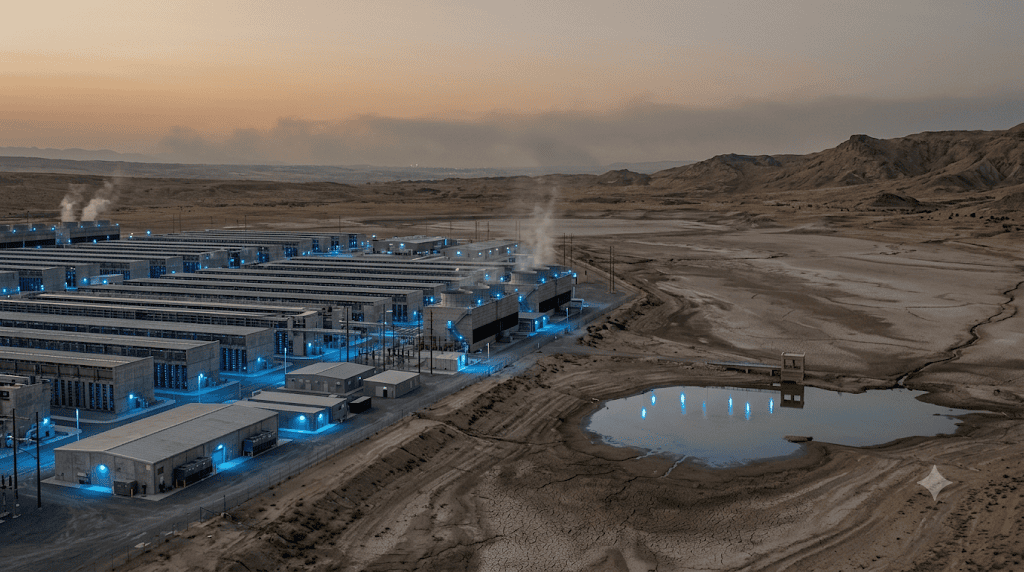
To understand the problem, you have to look at the physical reality. Right now, data centers eat up a little over 1% of global electricity [1]. That doesn’t sound like much until you look at the pressure points. In Ireland, data centers consumed over a fifth of the nation’s entire electricity supply in 2023—a number on track to breeze past 30% by 2026 [2]. Over in Northern Virginia, the undisputed data center capital of the world, the local utility had to double its long-term demand forecasts in just two years [3].
And it’s not just about training these massive models once. It’s the daily run-time. Every single ChatGPT prompt takes about ten times more energy than a quick Google search [4]. Multiply that by billions of daily queries, and the meter starts spinning fast.
Then there’s the water. Data centers are thirsty. A standard conversation of 20 to 50 questions essentially evaporates a half-liter bottle of water to keep the servers cool [5]. In drought-prone areas like Arizona, Spain, or Chile, locals are understandably fighting back against new server farms.
We also have to talk about the physical junk. The specialized chips that run AI (like Nvidia’s GPUs) have a brutal shelf life, usually just three to five years before they’re obsolete. Yet, global e-waste is growing five times faster than our capacity to recycle it [6].
For a long time, the tech sector treated computing power like it was infinite and free. It isn’t.
Where AI Actually Helps
But it’s not all doom and gloom. If we look at where AI is being applied, the environmental wins are tangible.
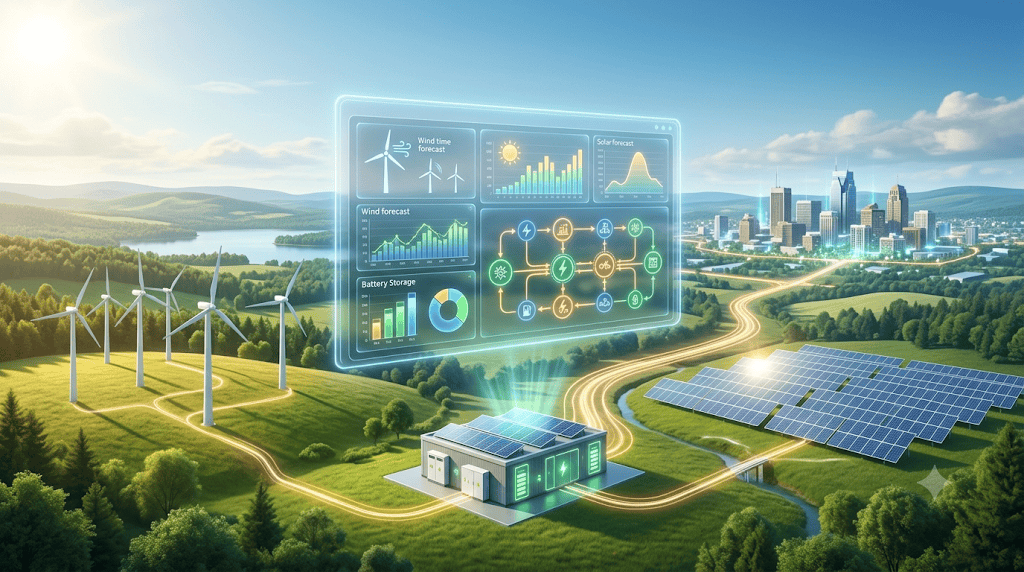
Take the power grid. As we plug in more wind and solar, the grid gets incredibly complicated to manage because the sun doesn’t always shine and the wind doesn’t always blow. AI is brilliant at this kind of puzzle matching, fluctuating supply with real-time demand and managing battery storage. Google used its own AI to slash its data center cooling energy by 40% [7], and those same math models are now being used to steady public power grids.
In manufacturing, AI is acting like a digital mechanic, analyzing vibrations and temperatures to predict when heavy machinery is about to break down. This keeps plants running efficiently and stops energy leaks. A World Economic Forum report suggests these kinds of digital optimizations could help slice global emissions by 20% by mid-century [8].
You see similar wins in logistics, where companies like UPS and Amazon use machine learning to dynamically reroute delivery trucks around traffic and weather, saving millions of gallons of fuel. In agriculture, smart cameras and sensors let farmers pinpoint exactly which crops need water or fertilizer, cutting water waste and reducing the runoff that poisons local ecosystems [9].
These aren’t theoretical “future tech” concepts. They are active, working programs. The real race is whether these efficiencies can scale faster than the energy demand of the AI models running them.
The Playbook for “Green AI”
For a long time, AI researchers only cared about one thing: accuracy. Now, we are seeing a massive shift toward efficiency. The industry is starting to adopt a few practical rules of thumb:
- Carbon-Aware Scheduling: Why train a massive model at 2:00 PM on a hot afternoon when the grid is strained and running on coal? Smart teams are shifting heavy training runs to the middle of the night, or to regions where cheap hydro or wind power is abundant, cutting emissions by up to half with a single line of code.
- Ditching “Bigger is Better”: The obsession with giant, trillion-parameter models is giving way to “right-sized” engineering. Smaller, highly specialized models (like Mistral’s Mixtral or Google’s Gemma) can often do a specific job just as well as a massive general-purpose model, using a fraction of the power.
- Regulation with Teeth: Voluntary corporate pledges are nice, but rules work better. The EU’s AI Act is beginning to force companies to actually report the energy and resource footprints of their high-risk systems [11]. Once you have to measure it, you start trying to fix it.
The Bottom Line
AI isn’t some autonomous force of nature acting on its own. It is a collection of engineering choices made by real people, working for specific companies, responding to market incentives.
If we default to laziness, training bloated models on fossil-fueled grids and treating electronics as disposable, then AI will absolutely be a net negative for the environment. But if we make efficiency a core engineering requirement, we can use this computing power to seriously accelerate our transition to a cleaner economy.
The concrete is being poured right now. How we manage this build-out over the next few years will set our course for the next decade. The tech doesn’t care either way; the responsibility is entirely ours.
References
- International Energy Agency. (2024). Data Centres and Data Transmission Networks.
- EirGrid. (2024). All-Island Generation Capacity Statement 2024-2033.
- Dominion Energy. (2024). 2024 Integrated Resource Plan.
- de Vries, A. (2023). “The growing energy footprint of artificial intelligence.” Joule, 7(10), 2191-2194.
- Li, P., et al. (2023). “Making AI Less ‘Thirsty’: Uncovering and Addressing the Secret Water Footprint of AI Models.” arXiv preprint.
- United Nations Institute for Training and Research. (2024). Global E-waste Monitor 2024.
- DeepMind. (2016). “DeepMind AI Reduces Google Data Centre Cooling Bill by 40%.”
- World Economic Forum. (2024). “How digital solutions can slash emissions by 20% by 2050.”
- World Economic Forum. (2020). “How AI can enable a sustainable future.”
- Schwartz, R., et al. (2020). “Green AI.” Communications of the ACM, 63(12), 54-63.
- European Commission. (2024). “AI Act enters into force.”
- Green Software Foundation. (2023). Software Carbon Intensity (SCI) Specification.