
What is Bitcoin? The Nitty and Gritty Guide
So the new topic that is raving all over within the news and around the water cooler is Bitcoins. Everyone wants to know what it is, how to use it and is it even worth it?
So to start the definition that investor should be familiar is :
Bitcoin is a crytocurrency, a form of electronic cash.
It is a decentralized digital currency without a central bank or single adminstrator that can be sent from user to user on peer-to-peer bitcoin blockchanin network without the need for intermediaries.
I will explain how the system works, how you can use it for your profit, which scams to avoid. I will also direct you to resources that will help you store and use your first pieces of digital currency.
Small wonder that Bitcoin emerged in 2008 just after Occupy Wall Street accused big banks of misusing borrowers’ money, duping clients, rigging the system, and charging boggling fees. Bitcoin pioneers wanted to put the seller in charge, eliminate the middleman, cancel interest fees, and make transactions transparent, to hack corruption and cut fees. They created a decentralized system, where you could control your funds and know what was going on.
Bitcoin has come far in a relatively short time. All over the world, companies, from REEDS Jewelers, a large jewelry chain in the US, to a private hospital in Warsaw, Poland, accept its currency. Billion dollar businesses such as Dell, Expedia, PayPal, and Microsoft do, too. Websites promote it, publications such as Bitcoin Magazine publish its news, forums discuss cryptocurrency and trade its coins. It has its application programming interface (API), price index, and exchange rate.
Problems include thieves hacking accounts, high volatility, and transaction delays. On the other hand, people in third world countries may find Bitcoin their most reliable channel yet for giving or receiving money.
Key Highlights
- October 31, 2008: Bitcoin whitepaper published.
- January 3, 2009: The Genesis Block is mined.
- January 12, 2009: The first Bitcoin transaction.
- December 16, 2009: Version 0.2 is released.
- November 6, 2010: Market cap exceeds $1 million USD.
- October 2011: Bitcoin forks for the first time to create Litecoin.
- June 3, 2012: Block 181919 created with 1322 transactions. It is the largest block to-date.
- June 2012: Coinbase launches.
- September 27, 2012: Bitcoin Foundation is formed.
- February 7, 2014: Mt. Gox hack.
- June 2015: BitLicense gets established. This is one of the most significant cryptocurrency regulations.
- August 1, 2017: Bitcoin forks again to form Bitcoin Cash.
- August 23, 2017: SegWit gets activated.
- September 2017: China bans BTC trading.
- December 2017: First bitcoin futures contracts were launched by CBOE Global Markets (CBOE) and the Chicago Mercantile Exchange (CME).
- September 2018: Cryptocurrencies collapsed 80% from their peak in January 2018, making the 2018 cryptocurrency crash worse than the Dot-com bubble’s 78% collapse.
- November 15, 2018: Bitcoin’s market cap fell below $100 billion for the first time since October 2017.
- October 31, 2018: 10-year anniversary of Bitcoin.
Understanding Bitcoin – What is Bitcoin in-depth?
At its simplest, Bitcoin is either virtual currency or reference to the technology. You can make transactions by check, wiring, or cash. You can also use Bitcoin (or BTC), where you refer the purchaser to your signature, which is a long line of security code encrypted with 16 distinct symbols. The purchaser decodes the code with his smartphone to get your cryptocurrency. Put another way; cryptocurrency is an exchange of digital information that allows you to buy or sell goods and services.The transaction gains its security and trust by running on a peer-to-peer computer network that is similar to Skype, or BitTorrent, a file-sharing system.
Bitcoin Transactional properties:
1.) Irreversible: After confirmation, a transaction can‘t be reversed. By nobody. And nobody means nobody. Not you, not your bank, not the president of the United States, not Satoshi, not your miner. Nobody. If you send money, you send it. Period. No one can help you, if you sent your funds to a scammer or if a hacker stole them from your computer. There is no safety net.
2.) Pseudonymous: Neither transactions or accounts are connected to real-world identities. You receive Bitcoins on so-called addresses, which are randomly seeming chains of around 30 characters. While it is usually possible to analyze the transaction flow, it is not necessarily possible to connect the real world identity of users with those addresses.
3.) Fast and global: Transaction is propagated nearly instantly in the network and are confirmed in a couple of minutes. Since they happen in a global network of computers they are completely indifferent of your physical location. It doesn‘t matter if I send Bitcoin to my neighbor or to someone on the other side of the world.
4.) Secure: Bitcoin funds are locked in a public key cryptography system. Only the owner of the private key can send cryptocurrency. Strong cryptography and the magic of big numbers makes it impossible to break this scheme. A Bitcoin address is more secure than Fort Knox.
5.) Permissionless: You don‘t have to ask anybody to use cryptocurrency. It‘s just a software that everybody can download for free. After you installed it, you can receive and send Bitcoins or other cryptocurrencies. No one can prevent you. There is no gatekeeper.
Where can I find Bitcoins?
First, we would recommend you read this in-depth guide for buying Bitcoin.
You can get your first bitcoins from any of these four places.
- A cryptocurrency exchange where you can exchange ‘regular’ coins for bitcoins, or for satoshis, which are like the BTC-type of cents. Resources: Coinbase and Coinsquare in the US & Canada, and BitBargain UK and Bittylicious in the UK.
- A Bitcoin ATM (or cryptocurrency exchange) where you can change bitcoins or cash for another cryptocurrency. Resources: Your best bets are BTER and CoinCorner
- A classified service where you can find a seller who will help you trade bitcoins for cash. Resources: The definitive site is LocalBitcoins.
- You could sell a product or service for bitcoins. Resources: Sites like Purse.
Caution! Bitcoin is notorious for scams, so before using any service look for reviews from previous customers or post your questions on the Bitcoin forum.
How To Buy Bitcoin Anywhere?
If you want to buy cryptocurrency quick and easily with your credit card check out the CoinBase!
There are a lot of options on how to buy Bitcoin, available in nearly every country of the world from, Gift cards, ATM, local Traders, broker, exchanges: A better guide that will explains, how to buy Bitcoin anywhere in the world.
Maybe you heard about this crazy cryptocurrency Bitcoin. The future of money, the revolution of payment, the digital gold, slayer of capital controls, holy grail of Fintech. Now you maybe want to know more. The best way to learn is just to try it. Buy a Bitcoin, pay with it, store it in your digital wallet, watch the price rise or go down. But where can you buy it? And how?
For many people, the first acquisition of a Bitcoin is a terrifying process. It seems so complicated. But actually, it is not. There are a lot of options to easily, fast and comfortably buy your first Bitcoin.
Which one is the best depends on your country and your preferences?
If you are in a hurry, you can just click on the link in the table to find out your options on how to buy Bitcoin.
TLDR:
- Use Regular Fiat Money to Buy Bitcoin.
- Once you have a Bitcoin wallet, you use a traditional payment method such as a credit card, bank transfer (ACH), debit card, interact or E-transfer to buy Bitcoins on a Bitcoin exchange.
- The Bitcoins are then transferred to your crypto wallet.
To find the perfect method to buy your first Bitcoin however you should first take into account several factors:
- How much private information do you want to disclose?
- How do you want to pay?
- Where do you live
Depending on these factors you should easily be able to decide which platform fits your needs.
I will explain the options you have to disclose private information (or not disclose it) and include what payment channels you can use. After this, you will find the common methods that is most popular to buy Bitcoin.
How To Buy Bitcoin Anywhere in The World
Private Information
Bitcoin is a financial tool and thus subject to financial regulation in most jurisdictions. Nearly everywhere Anti-Money-Laundering-Rules (AML) are applied to platforms that sell Bitcoins or enable users to buy and sell Bitcoins. Most of these platforms have to adopt Know Your Customer rules (KYC) to verify the identity of its users.
Since Bitcoin transactions are saved publicly visible on the blockchain and can be traced back, the degree of private information you disclose with buying Bitcoins can have serious implications on your privacy.
There are several grades of KYC with an increasing amount of private information you have to disclose. The following list starts with the lowest grade:
- No KYC: No KYC means that the platform or the seller of Bitcoins does not know who you are. You don‘t have to show an identity document, and you pay with a private means of payment like cash, Moneygram, Paysafecard or Western-Union. Buying Bitcoin without KYC is possible in some jurisdictions – for example with P2P-marketplaces like LocalBitcoins, ATMs or Gift Cards – but is usually more expensive than other options.
- KYC Light: This degree of KYC identifies you by your payment channel and/or your phone numbers. If you pay with your bank account, PayPal, credit card or other common means of payment, the payment providers know your identity. On most platforms, be it direct exchanges, exchange platforms or marketplaces, you can buy a limited amount of Bitcoins with KYC Light.
- Full KYC: On top of verifying your identity with your phone number and your bank account, Full KYC means that you provide documents that prove your identity. This can be a passport, an ID card, a driver‘s license, a utility bill or a combination of all of this. Some platforms demand that you provide an approval of your identity documents by a notary or a trusted third party like your bank; some are satisfied if you submit a photo showing you holding your ID card or take part in the process of video identification. If you want to invest larger amounts of money or trade on exchanges, there‘s usually no way around Full KYC.
Payment
Bitcoin is money, but to buy Bitcoins, you need to send money to someone else. The more advanced the financial system of your country is, The better the financial system you live in, the easier it is to exchange your money in Bitcoins.
Here is an incomplete not-complete list of commons means of payment to buy Bitcoin:
- Bank transfer: Everybody might know the good old Bank transfer. Mostly with online banking you send money to a seller of Bitcoins and get the Bitcoins when the payments are done. In most countries, this needs 1-3 days. Direct debiting is usually not accepted common. Most exchange platforms only accept bank transfers.
- Credit Card: Credit cards are one of the most common means of payment. But only a few direct commercial vendors accept credit cards. The reason is that Bitcoin transactions cannot be undone, while credit card transactions can be reversed. This has resulted in losses for vendors which accepted credit cards. Also, vendors risk that people buy Bitcoin with stolen credit cards.Use Bitcoins to profit from stolen credit card numbers and apply algorithms to reduce the risk.
- PayPal: A few platforms accept PayPal, but most reject it for the same problems as credit cards: PayPal transactions can be easily undone, and when this is done after the buyer has transferred the acquired Bitcoin to another wallet, the vendor might lose. This is why eBay is a bad place to trade Bitcoins. But, like with credit cards, some platforms accept PayPal.
- Other Payment Channels (Sofort, iDeal, Skrill…): The world of payment is rich with payment providers. In the EU alone you have dozens of them. Many direct exchanges support a rich collection of them. If you use a common provider, in Germany Sofort, in the Netherlands iDeal and so on, you have a good chance that your domestic direct exchange accepts it.
- Private Payment Channels (Cash, Western Union, Paysafecard, etc.): Most commercial platforms don‘t accept these means of payment. You find very few exchange platform and most probably no direct exchange where these payments are accepted. But often you‘ll find a seller on p2p marketplaces you can pay with cash or other private means of payments. A good chance might also be an ATM where you can buy Bitcoins with cash.
Different Ways To Buy Bitcoin
Now we‘re coming closer to the acquisition of your Bitcoin. In this part of our guide, we present you several common models that enable you to change fiat-money to digital cash – in Bitcoin. Each model has its own advantages and disadvantages.
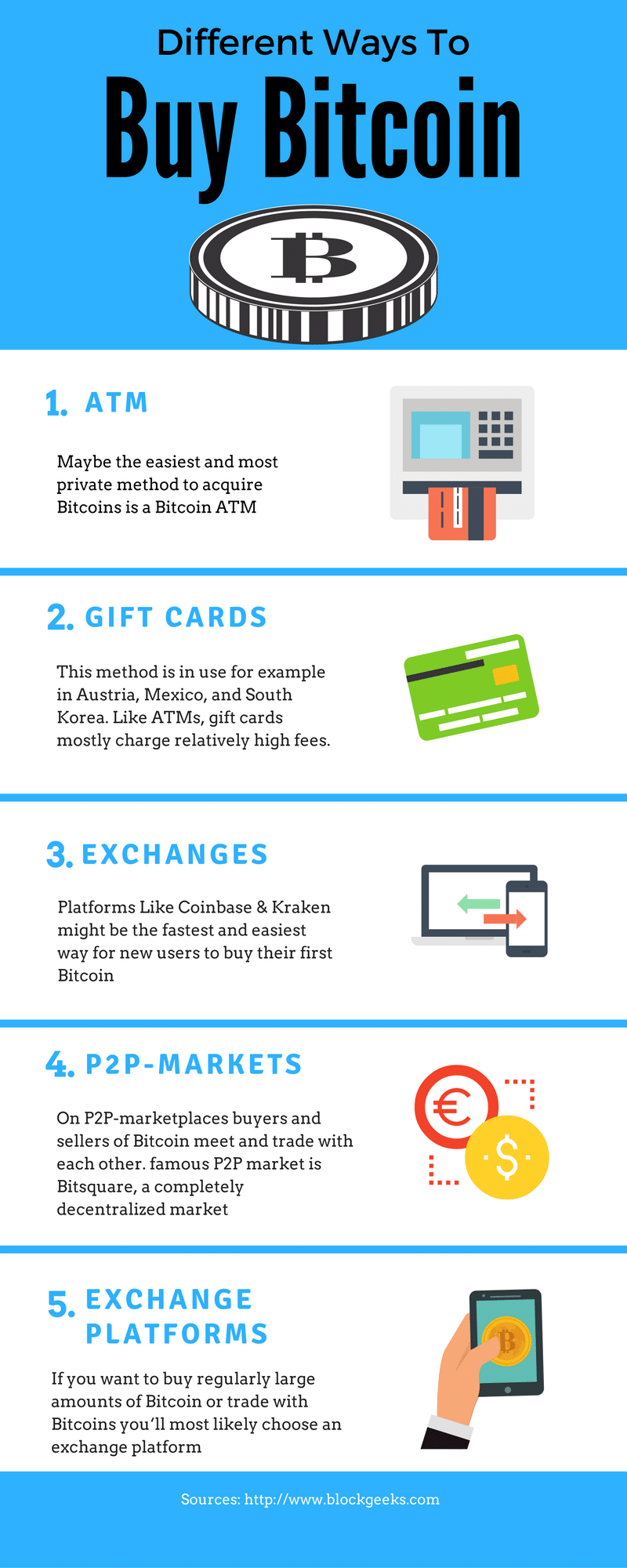
- ATM: Maybe the easiest and most private method to acquire Bitcoins is a Bitcoin ATM. You know it, these machines where you can get money with your card. Some companies like Lamassu produce ATM-machines for Bitcoins, where you can buy Bitcoin with cash. If the operators of these machines wish, they can apply some KYC-rules, from mobile phone verification to biometric methods. On Coin-ATM-Radar.com you find a global map with these machines. Another kind of ATM is to just use an existing net of ATMs, like that from banks or train stations, to sell Bitcoins. This has been done for example in the Swiss, in the Ukraine or in Spain. ATMs mostly have a relatively high fee of 3-6 percent or even more.
- Gift Cards/Voucher: This is another easy method to buy Bitcoins. You go to a kiosk or some other shop, buy a gift card or a voucher, visit a website, where you can use the code on the card to get your Bitcoin. This method is in use for example in Austria, Mexico, and South Korea. Like ATMs, gift cards mostly charge relatively high fees.
- Direct commercial exchanges/brokers: These vendors are like the exchange offices you might know from an airport, but digital. They buy Bitcoins on an exchange and sell it to customers. You visit a website, choose your means of payment, pay and get Bitcoins for prices set by the platform. For most of these platforms, you need your own wallet, while some, for example, Coinbase and Circle, give you the option to save and spend the Bitcoins with a wallet they provide. Since you can use a great variety of payment channels, even credit cards, and PayPal, such platforms might be the fastest and easiest way for new users to buy their first Bitcoin. The fees of direct commercial exchanges vary between 1 and 5 percent. Some of them earn money by using the spread between buy and sell. Most demand extra fees for some means of payment like credit cards.
- P2P-Markets: On P2P-marketplaces buyers and sellers of Bitcoin meet and trade with each other. The fees on these markets are relatively low with 0 to 1 percent; the spread depends on the liquidity of the market and the payment channel. Other than with direct you can not only take, but make an offer: You set a price and wait until someone sells you a Bitcoin. This enables you to buy relatively large amounts of Bitcoin at relatively low prices. The most famous P2P-market is LocalBitcoins. This worldwide platform serves a lot of currencies and lets buyers and sellers decide which means of payment they use. It is often used to facilitate anonymous exchanges, sometimes for extraordinarily high prices. Bitcoin.de, the largest P2P-market in the Eurozone offers a good liquidity and is a nice option to easily change Euro to Bitcoin. The third famous P2P market is bitsquare, a completely decentralized market, which is nothing more than a software that connects people.
- Exchange platforms: If you want to buy regularly large amounts of Bitcoin to good prices or trade with Bitcoins you‘ll most likely choose an exchange platform. Exchanges act as an escrow for its clients and save both Bitcoin and Fiat-money on behalf of their customers. Here you can offer your own orders to buy or sell Bitcoin, and the Their trading engine of the exchanges cumulates these orders and s offers from buyers and sellers and processes trades. Often exchanges have more options to trade like margin trading. Usually, fees and the spread are low. But the process to start an account on exchanges can be complicated, requires privacy disclosing information and needs you to trust the exchange with your money.
Warnings about exchanges, wallets and banks
Despite the proof of identity requirements, remember exchanges and wallets don’t provide the same protections banks do.
For example, there is often no or limited insurance for your account if the exchange goes out of business or is robbed by hackers, such as was the case with the infamous failed exchange Mt Gox.
Bitcoin does not have legal status as a currency in most of the world, and authorities usually do not know how best to approach thefts. Some larger exchanges have replaced customer funds after a theft from the exchange itself, but at this stage, they are not legally obliged to do so.
How to buy Bitcoin in your country?
Worldwide: Understand nearly everywhere in the world, you have a chance to use local bitcoins, BitSquare or a Bitcoin ATM. While these are options you could use, it is worth to look for further options available in your country. Below I am only going to reference the buying of bitcoin only with the USA
USA
The USA is one of the biggest markets for Bitcoin buyers. Buyers can choose from a wide variety of options to buy Bitcoins that you will, you find beside LocalBitcoins and ATMs the direct vendors Coinbase, Circle, and India coin, the P2P-market Paxful and the exchange Kraken.
Buy Bitcoin In USA
- Direct Exchanges: With Coinbase and Kraken two major platforms offer an easy way to buy Bitcoins with low fees and save them in an online-wallet. Both platforms accept both bank transfers and credit cards. Indacoin is another platform for the direct exchange, but without an integrated wallet. A next option, Expresscoin, enables the acquisition of Bitcoins with cash via Billpay.
- P2P-Markets: Beside LocalBitcoins and Bitsquare Bitquick and Paxful are P2P-markets available for customers in the US. On Bitquick you pay by depositing leaving cash on the bank of the seller, on Paxful the seller can choose whatever payment-channel he wants, including PayPal, Western Union, credit and debit cards, gift cards and much more. While prices on Paxful are usually quite high, Bitquick charges a fee of 2 percent.
- Exchanges: If you want to buy Bitcoins with Dollar on an exchange, you have a couple of platforms to choose. The biggest exchanges are Bitstamp; Coinbase‘s GDAX and Bitfinex, followed by BTC-E, Kraken, and Gemini. While most exchanges strictly accept bank transfers, BTC-E offers additionally the funding of an account with Credit Cards and payment providers like PerfectMoney, Paysafecards and more.
Now for the Conclusion
Buying bitcoins is not always as easy as newcomers expect. The good news is the number of options is increasing, and it is getting easier all the time.